




There is a meeting most marketing leaders know well.
You present the growth plan. Ten minutes later, nobody is talking about the strategy anymore. Finance is questioning the pipeline numbers, sales is challenging the conversion assumptions, and the whole meeting turns into a debate about whether the forecast can be trusted.
The plan might have been good. The model killed it.
A growth model is meant to prevent that.
It is not a forecast pulled from thin air, and it is not a budget with a target return attached. It is a written view of how the business should grow, expressed through numbers that can be checked.
The goal is simple: instead of asking “Can we trust marketing?”, the conversation becomes “Which assumption should we test first?”
What a Growth Model Is Not
A growth model is not last year’s revenue multiplied by 20%.
It is not a channel budget with an expected ROAS added to it. And it is not a pipeline spreadsheet where every marketer enters the leads they expect their campaigns to generate.
That last one is especially common.
The person responsible for the budget is also estimating the result. Finance naturally has questions about that.
A useful model is different. It connects a series of assumptions, and every assumption is either supported by your own data or clearly marked as an estimate.
That makes it much easier to see which numbers actually matter.
The Four Parts of a Useful Model
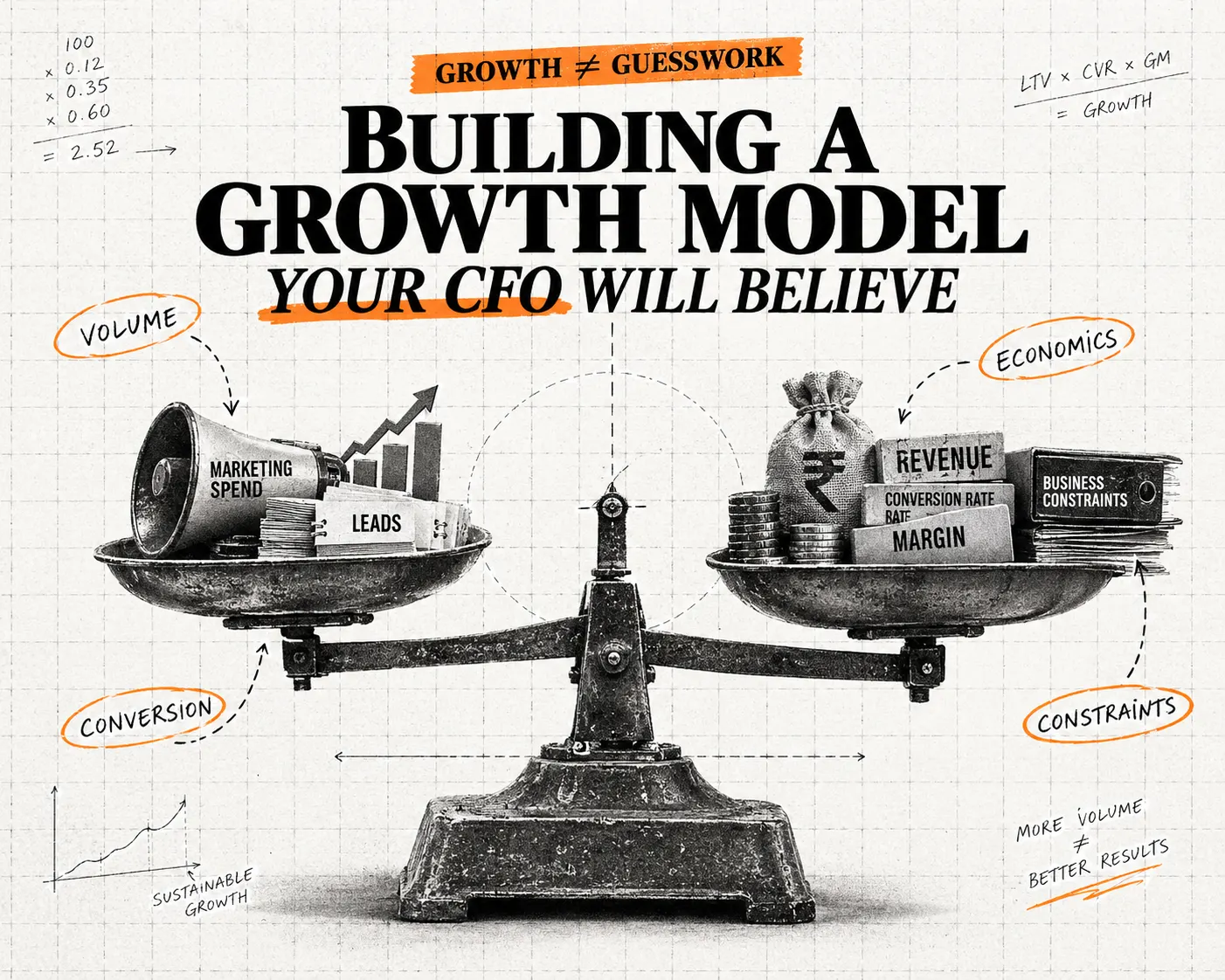
We normally build a growth model around four layers.
1. Volume
How many people enter the funnel each month, and where they come from.
For example:
- Google Ads
- Meta Ads
- Organic search
- Partner referrals
This is usually the easiest part because you can compare it with historical data.
2. Conversion
How many people move from one stage to the next.
Do not use one blended conversion rate for every channel.
Paid search, organic traffic, referrals, and paid social can bring very different types of customers. Combining them into one number hides that difference.
3. Economics
Now bring in the numbers finance actually cares about:
- Average contract value
- Gross margin
- Sales cycle
- Revenue by source
A model that stops at revenue is incomplete.
Finance cares about how much money is left and when that money actually arrives.
4. Constraints
This is the part marketing models often forget.
Can sales actually handle the extra leads?
Can the delivery team serve the extra customers?
Do you have enough account executives, onboarding staff, or customer support?
If the model predicts three times more customers with the same sales and delivery capacity, it is not really predicting revenue. It is predicting a backlog.
“A model that only produces the number you wanted is not a model. It is a slide with arithmetic on it.”
Separate What You Know From What You Assume
This is one of the simplest ways to make a model more credible.
Mark every important input as one of three things:
Measured: based on your own historical data.
Benchmarked: based on an external benchmark.
Assumed: a number you are currently estimating.
The first time you do this, you may find that more of the model is based on assumptions than expected.
A conversion rate might come from one quarter two years ago. Average contract value might be heavily influenced by one unusually large customer.
That is not a reason to hide the problem.
It is the reason to build the model.
Sensitivity Is More Useful Than Fake Precision
Finance does not need you to pretend that every number is exact.
They need to know what happens if your assumptions are wrong.
Take the major inputs and move them up and down. For example, change each one by 20% and see what happens to the annual result.
You will usually find that two or three assumptions have a much bigger impact than everything else.
That gives the team something useful to work on.
If conversion rate and average contract value are driving most of the model, those are the numbers you should spend time measuring properly.
Reconcile It Every Month
A growth model that appears once during budget planning and then disappears into a spreadsheet folder is not very useful.
Reconcile it against actual results every month.
For each major assumption, ask:
What did we expect?
What actually happened?
Why was there a difference?
Is it normal variation or something we need to change?
After a few months, the team starts building a track record.
If the model has stayed within 10% of actual results for six months, the next planning meeting becomes much easier. People can discuss the plan instead of spending the entire meeting attacking the assumptions.
Where Growth Models Usually Go Wrong
They stop at leads
Leads are useful to marketing.
Revenue is useful to the whole company.
If your model stops at leads, finance will treat it as a marketing report rather than a business model.
They assume channels scale linearly
Doubling Google Ads spend does not automatically double conversions.
At some point, you reach less efficient audiences and higher costs.
Even a simple saturation assumption is better than pretending the relationship is perfectly linear.
They ignore timing
If your average sales cycle is 90 days, spending money in December may create revenue in March.
A model that treats spending and revenue as happening in the same month can look great on paper and create serious cash-flow problems.
They hide the assumptions
If nobody outside marketing can open the model, understand it, and challenge the inputs, they will not trust it.
The model needs to be understandable enough for finance and sales to question it.
Do Not Make the Model Too Complicated
Most teams build too much.
Four acquisition sources, three funnel stages, average contract value, and a few honest assumptions can be more useful than a spreadsheet with 22 channels and hundreds of campaign-level inputs.
Every additional input is another assumption.
Our rule is simple:
If you cannot explain the model in about 15 minutes, it is probably too complicated.
A model should help people make decisions, not give them more tabs to maintain.
Build the First Version on One Page
Start small.
Use four acquisition sources and track:
- Monthly volume
- Conversion to closed-won
- Average contract value
- Revenue
- The three assumptions you are least confident about
Then test the model against the previous 12 months.
If it cannot reasonably explain what already happened, there is little reason to believe it will predict what happens next.
The first version does not need to be perfect. It needs to be honest.
Get Finance Involved Before the Numbers
One of the best ways to make finance trust the model is to involve them before you build it.
Have one meeting and ask:
What does finance need this model to answer?
What has made previous marketing forecasts difficult to trust?
The answers are usually practical.
They may want cash timing rather than just annual revenue. They may want the model to match the categories already used in the finance plan. They may want to know which budget line gets cut first if the quarter comes in below target.
Those are easy requirements to build into the model when you know them early.
Finance stops being the team checking the model after it is finished and becomes part of building it.
What Happens When the Model Is Wrong?
It will be wrong at some point.
That is normal.
The mistake is quietly changing the assumptions until the model matches reality.
If you predicted a 15% conversion rate and got 9%, leave the original 15% visible.
Write down what happened and why.
Maybe the lead mix changed. Maybe the sales team had less capacity. Maybe the assumption was simply wrong.
That history becomes valuable.
Over time, you have a record of what the business actually does and how your assumptions have changed.
We keep a change log for exactly this reason.
Two Questions That Expose a Weak Model
If someone hands you a growth model, ask two questions.
“What would have to be true for this model to be wrong by half?”
A good model should have an answer. Usually, one or two assumptions will stand out.
Then ask:
“Show me the month when this model was most wrong last year.”
If nobody knows, the model has not really been tested.
A detailed spreadsheet can still be completely unproven.
The Real Benefit
The value of a growth model increases every month you use it.
Each reconciliation tells you which assumptions were close and which were wrong. Those results make the next version better.
After a year, you should have much more than a forecast.
You should know your conversion rates, sales cycle, customer value, channel economics, and the assumptions that actually drive growth.
That changes the conversation with finance.
You are no longer asking them to believe a marketing forecast.
You are showing them how the business grows, what you know, what you are still testing, and where the biggest risks are.
That is the kind of growth model a CFO can actually work with.


Leave a Comment